
Abdominoplasty
Abdominoplasty or tummy tuck is a surgical procedure performed to treat sagging, excess skin and excess fat in the middle and lower abdomen, and to restore and tighten the muscles of the abdominal wall that have become loose.
In women, it is usually performed after multiple pregnancies, to treat the annoying stretch marks that form, while in both sexes, it definitively treats the lack of elasticity and sagging skin after weight loss, ring or gastric bypass surgeries.
In cases where fat removal and skin sagging cannot be treated with liposuction in combination with intense athletic activity and various diet programs, e.g., pronounced skin sagging, older people with low skin elasticity, then we resort to abdominoplasty.
Abdominoplasty dramatically reduces the size of the abdomen and improves the overall appearance of the body.
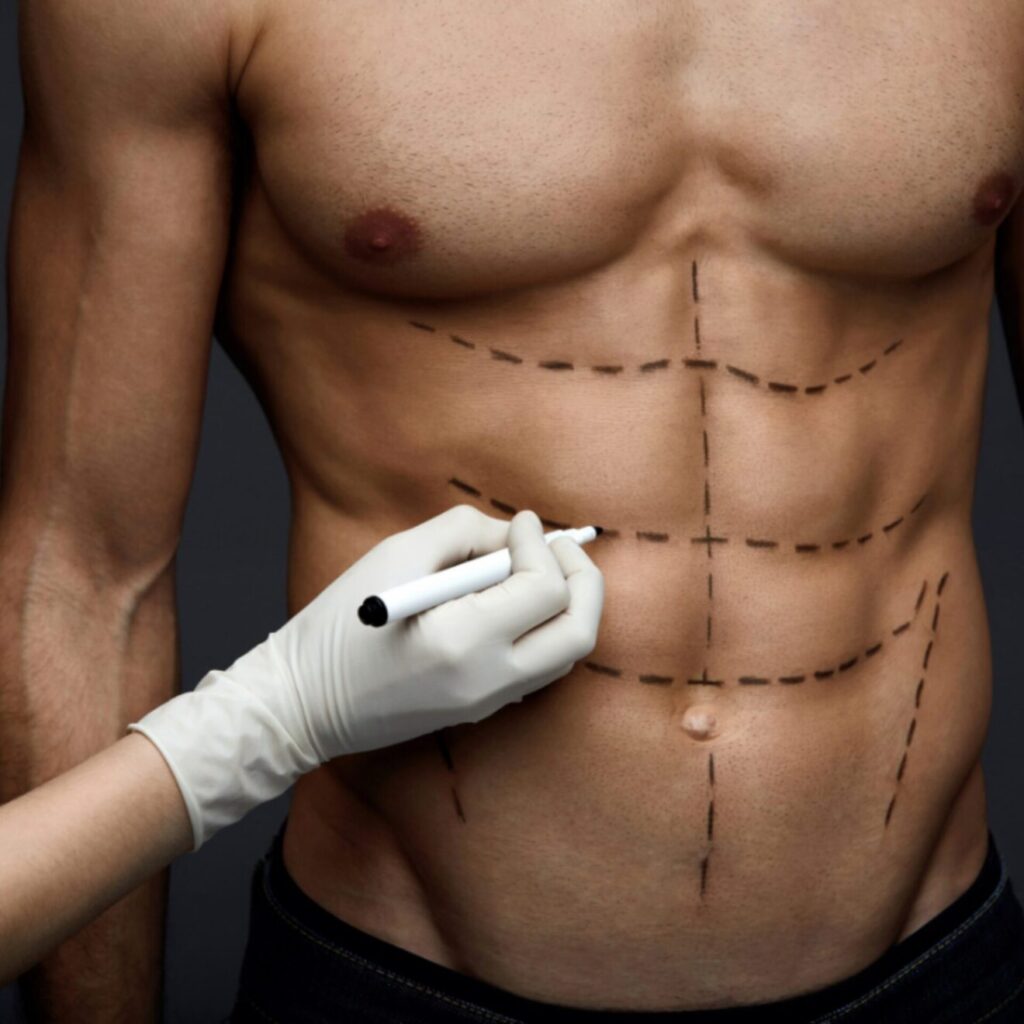
In our effort to achieve the best possible result depending on the specifics of each individual, abdominoplasty is classified into various categories, with the most common being the well-known classic abdominoplasty.
It involves removing excess skin and fat and tightening the abdominal muscles with an incision above the pubis where it extends from one iliac crest to the other, allowing us to reduce the size of a sagging belly.
Depending on the extent of the surgery, classic abdominoplasty usually lasts from 2 to 3 hours.
Mini abdominoplasty is indicated for those interested in having a small amount of excess skin and fat in the lower abdomen, where an incision is made (similar to a cesarean section) and a smaller section of abdominal skin is removed without moving the navel.
It is usually applied to women who are relatively thin and are concerned about stretch marks or deformities that occur in the lower part of the abdominal wall.

The incision is relatively small and is placed in a place where it is covered by underwear. The mini abdominoplasty lasts less than 2 hours and is performed under local anesthesia or sedation and does not require the patient to stay in the clinic.
A variation of the Mini Abdominoplasty is indicated for those interested in having a small amount of excess skin and fat in the lower abdomen where the underlying abdominal muscles are loose and restoration and tightening with sutures is performed.
The surgery is also called a body lift or belt lipectomy.
It is suitable for people who have lost a lot of weight after anti-obesity surgery (gastric band placement, stomach compartment surgery), where the removal of skin and fat is extensive.
Skin and fat are removed circumferentially around the waist, and it is very often combined with a simultaneous lift of the buttocks and thighs.
Abdominoplasty with simultaneous sculpting of the abdominal area with VASER High–Definition liposuction , shaping and toning of the abdominal muscles. Dr. Nikolaos Maltzaris exclusively applies the Vaser 4D High Definition liposuction method, the most advanced and innovative method that Hollywood stars have pioneered by transforming their bodies.
With the 4D High Definition liposuction method, excess fat is removed with the aim of having a flat and dynamically defined abdomen, firm arms, lifted buttocks (without localized fat) while at the same time revealing the muscular architecture of the body. The abdominal muscles, the 6-packs and 4-packs, the deltoids and back muscles are emphasized and the body has the lines that would otherwise require years of intensive exercise.
This creates a more athletic and toned body. Liposuction is also performed alongside liposuction. In other words, the fat that has been removed is transferred, adding curves to men and women where they need it.
The operation is performed under general anesthesia. With a horizontal incision a few centimeters above the pubis, designed so that it is covered by underwear.
The abdominal wall is prepared up to the thoracic sides, the rectus abdominis muscles are strengthened and tightened, and their size is corrected with sutures if there is any relaxation of the abdominal walls.
Excess skin is removed, pulled downwards and the navel is moved to its new position.
Drains are placed to prevent fluid collection postoperatively.
The stay in the clinic is approximately one to two days, with the majority of patients being discharged the day after surgery.
After surgery, the patient wears a special corset for 3-4 weeks.
From the very next day, the patient is mobilized immediately and you assist in his daily life for 4-5 days at home.
The patient does not feel pain, they simply feel a feeling of tension due to the tightening of the abdominal muscles and discomfort at the skin suture line.
Return to work occurs after 1-2 weeks and depends on the nature of the work and the temperament of each individual.
Jobs that do not require intense physical exertion require a shorter recovery period.
Full activity, sports activities and weight lifting are permitted after four weeks, and driving is permitted once they are completely free of any feeling of discomfort or restriction of movement.
In order to achieve the best aesthetic result in the overall appearance of the body, and when this does not pose other risks to the patient’s health, abdominoplasty surgery can be combined with liposuction, hernia repair and mesh placement surgeries, breast reduction, treatment of gynecomastia in men, etc.
Liposuction is the procedure we choose to treat localized accumulation of abdominal fat, both on the anterior surface and in the lateral abdominal areas, when there is no significant skin laxity and the abdominal muscles are in good condition.
In these cases, liposuction can give spectacular results.
However, in cases where the sagging of the abdominal skin is evident, as well as in cases where the abdominal muscles cannot maintain their tone (e.g. after pregnancies, large weight fluctuations, etc.), then abdominoplasty surgery is the one that can address these specific problems.
The surgery is considered safe and the rate of complications is very low when specific rules for proper preparation for the surgery are followed.
As with any surgical procedure, “complications” can occur with abdominoplasty.
They are not common and are reported as:
The results of the procedure can be permanent, especially if combined with a balanced diet and exercise, and as long as the patient does not subject their body to large fluctuations in weight.
A good preoperative check-up, a physical examination, the correct planning of the operation and the appropriate technique chosen by the Plastic Surgeon are the guarantee of the result.