Breast Lift
Breast sagging is a common legacy of motherhood, breastfeeding, and the force of gravity, which cause disruption of the ligaments that support the breasts. Over time, the skin loses its elasticity, its youthful shape, and the breasts begin to “sag.”
Breast lift or mastopexy
It lifts and restores the shape and firmness of the breasts, corrects their projection and contributes to the harmony of the body’s proportions without changing their volume.
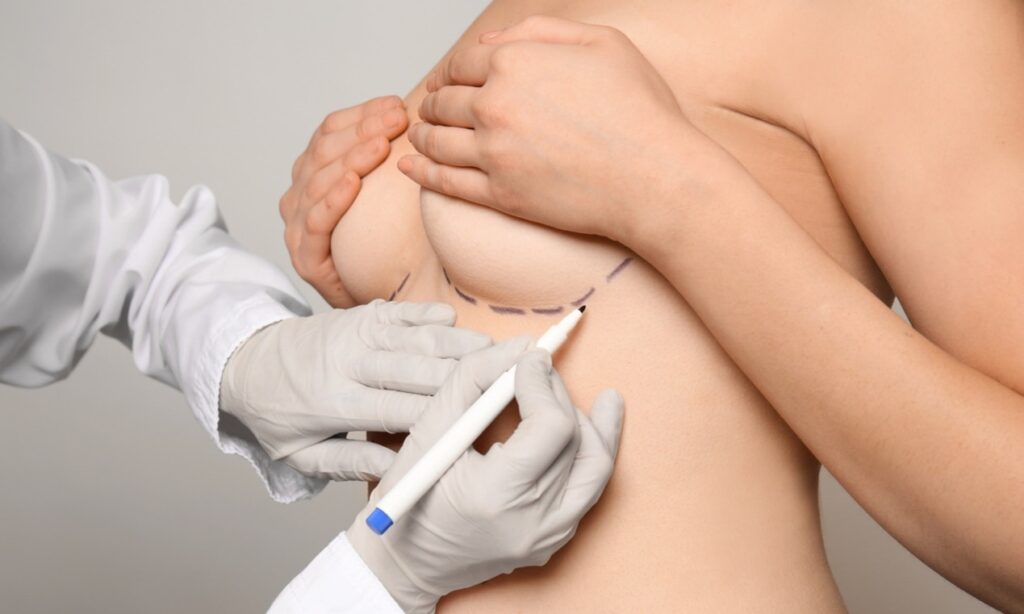
Breast augmentation is performed using various techniques and approaches, including circumvertical incision (Lolipop-circumvertical incision), circumvertical incision (JL) or inverted T incision
In specific cases, in combination with breast augmentation or reduction using silicone implants. In cases of slight sagging, breast augmentation with anatomical silicone implants corrects sagging without lifting. In cases of sagging breasts combined with loss of volume, a combination of lifting and augmentation with silicone implants or placement of autologous fat is needed.
Before surgery, a preoperative checkup with digital mammography and ultrasound is necessary, so that you have a benchmark for any future changes in your breast parenchyma.
The operation is performed under general anesthesia and a stay in the clinic is usually not necessary. Postoperatively, the patient wears a special sports bra for 1 month. The pain is mild and is treated with painkillers. The use of drains is usually not necessary. The sutures are absorbable and do not need to be removed.
The lifting techniques used depend on the degree of breast sagging, the position of the nipple in relation to the inframammary fold, and are divided into categories. A normal breast has the nipple and breast parenchyma (glandular tissue and fat that make up the breast) above the inframammary fold.
Grade 1 ptosis is mild sagging in which the nipple is at the level of the inframammary fold and the parenchyma below it. Usually, if the breasts are small, anatomical silicone implants are placed to address the ptosis.
Grade 2 ptosis is moderate ptosis in which the nipple is visible and below the level of the inframammary fold but remains above the lowest part of the parenchyma. In these cases, the nipple-areola complex needs to be lifted using a minimally invasive technique (peri-nipple and vertical mastopexy).
Grade 3 ptosis is a severe sagging in which the nipple is barely visible below the inframammary fold and is covered by the breast parenchyma. The lift is performed by removing excess skin and lifting the nipple-areola complex. Skin flaps are required to safely transfer the nipple to its new position.
Pseudoptosis is characterized by mild breast droop and the nipple is above the level of the inframammary fold. However, the majority of the breast parenchyma is below the level of the inframammary fold. In these cases, a portion of skin is removed and the nipple and areola complex is elevated.
Parenchymal asymmetry includes a lack of parenchymal fullness in the lower part (lower pole) of the breast, a high inframammary fold, a short distance of the nipple from the inframammary fold, a large areola, and is observed in congenital malformations such as tubular breasts.

After the surgery, you will be mobilized the same day and will perform light activities. You can return to your daily life and work in a week depending on the demands of the job. Of course, excessive physical exertion should be avoided for 2 to 3 weeks until the swelling has subsided. Driving is not allowed until you feel safe and comfortable wearing a seat belt. Full return to your sports activities is expected after 1 month.
The result of breast augmentation is immediately visible and the shape of the breast will continuously improve after the operation. Over time, there is a decrease in postoperative swelling and the scars from the incisions gradually fade. The final image is assessed approximately 2 months after the breast augmentation.
As with all surgeries, there are complications in breast augmentation. Although rare, it is important to weigh them against the potential benefit of the surgery. Postoperative complications of breast augmentation include scar hypertrophy, inflammation, hematoma formation, breast asymmetry, nipple hypoesthesia, and reduced ability to breastfeed.
During your visit to the clinic with Dr. Maltzaris, the existing options that are in line with your wishes, the details of the procedure and the cost of breast augmentation will be thoroughly analyzed.

ΆΡΙΣΤΗΤο Trustindex επαληθεύει ότι η αρχική πηγή της κριτικής είναι Google. I’m so happy I found Dr Maltzaris 🤍 From the moment I walked in, I felt completely at ease. He took the time to really understand what I wanted and explained everything so clearly - no pressure, just honest advice. I’ve just had the Cellulite Killer treatment and already I can see and feel a difference. My skin feels tighter, smoother, and I just feel more confident. For me, it’s not just about how you look — it’s about how you feel in your body, and I genuinely feel amazing after this.Δημοσιεύτηκε στοΤο Trustindex επαληθεύει ότι η αρχική πηγή της κριτικής είναι Google. Μόνο τα καλύτερα έχω να πω για τον κύριο Μαλτζάρη. Από το πρώτο δευτερόλεπτο που μπήκα μέσα στο ιατρείο σε κάνει να νιώθεις ασφάλεια, άνεση και εμπιστοσύνη. Μου εξήγησε τα πάντα με απλό και κατανοητό τρόπο, δείχνοντας πραγματικό ενδιαφέρον και υπομονή στο πρόβλημά μου. Τελικά πήρα την απόφαση και προχώρησα μαζί του στην αυξητική μαστών που τόσα χρόνια ήθελα και κανένας άλλος δεν μου είχε βγάλει αυτήν την εμπιστοσύνη και πραγματικά μόνο ευτυχισμένη νιώθω από εκείνη την στιγμή. Η εμπειρία και ο επαγγελματισμός του φαίνονται αμέσως. Σίγουρα τον προτείνω ανεπιφύλακτα και αξίζει να κάνετε την επίσκεψη σας!Δημοσιεύτηκε στοΤο Trustindex επαληθεύει ότι η αρχική πηγή της κριτικής είναι Google. Επισκέφθηκα τον Δρ. Νικόλαο Μαλτζάρη στη Γλυφάδα για μεσοθεραπεία αντιμετώπισης κυτταρίτιδας και η εμπειρία μου ήταν πραγματικά εξαιρετική. Από την πρώτη στιγμή ο γιατρός με έκανε να νιώσω άνετα και ασφαλής, εξηγώντας με λεπτομέρεια τη διαδικασία και τι να περιμένω. Η θεραπεία ήταν πολύ πιο ανώδυνη απ’ όσο φανταζόμουν και έγινε με μεγάλη προσοχή και επαγγελματισμό. Ο χώρος είναι πολύ προσεγμένος και σύγχρονος και όλοι ιδιαίτερα ευγενικοι. Φαίνεται ξεκάθαρα ότι ο γιατρός δίνει μεγάλη σημασία στο φυσικό αποτέλεσμα και στην εξατομικευμένη προσέγγιση κάθε ασθενούς. Τον συστήνω ανεπιφύλακτα σε όποιον σκέφτεται να κάνει αντίστοιχη θεραπεία! Θα ξαναπάω σίγουρα!Δημοσιεύτηκε στοΤο Trustindex επαληθεύει ότι η αρχική πηγή της κριτικής είναι Google. Στον κο Μαλτζάρη έκανα τη θεραπεία με εξωσώματα . Ο ερεθισμός ήταν ελάχιστος , μελανιές δεν είχα καθόλου και την επόμενη μέρα το πρόσωπο μου έλαμπε ! Πρέπει να σημειωθεί ότι ο κος Μαλτζάρης έχει πάρα πολύ «ελαφρύ χέρι» και δεν σε πονάει καθόλου στις ενέσιμες θεραπείες ! Το ιατρείο πεντακάθαρο και η βοηθός του πάρα πολύ άμεση και εξυπηρετική .Δημοσιεύτηκε στοΤο Trustindex επαληθεύει ότι η αρχική πηγή της κριτικής είναι Google. Από τη πρώτη στιγμή μου ενέπνευσε εμπιστοσύνη ! Ευγενικός, επεξηγηματικός και ξέρει να κάνει σωστά τη δουλειά του! Έκανα θεραπεία με ορό και νιώθω άλλος άνθρωπος ! Σας ευχαριστώ!Δημοσιεύτηκε στοΤο Trustindex επαληθεύει ότι η αρχική πηγή της κριτικής είναι Google. Εξαιρετική εμπειρία εγώ προσωπικά έκανα rf micronidling και συστήνω ανεπιφύλακταΔημοσιεύτηκε στοΤο Trustindex επαληθεύει ότι η αρχική πηγή της κριτικής είναι Google. Εξαιρετικός γιατρός & άνθρωπος. Σε ένα ευχάριστο & φιλικό περιβάλλον απολαυσα τις θεραπείες που μου σύστησε